
A Commercial Note by OP Contract
How to Write the Perfect Variation
Why making your client's life easier might be the best commercial strategy you have
- Author
- John Paul Oliver
- Reading time
- 9 min read
- Audience
- For fabricators & contractors
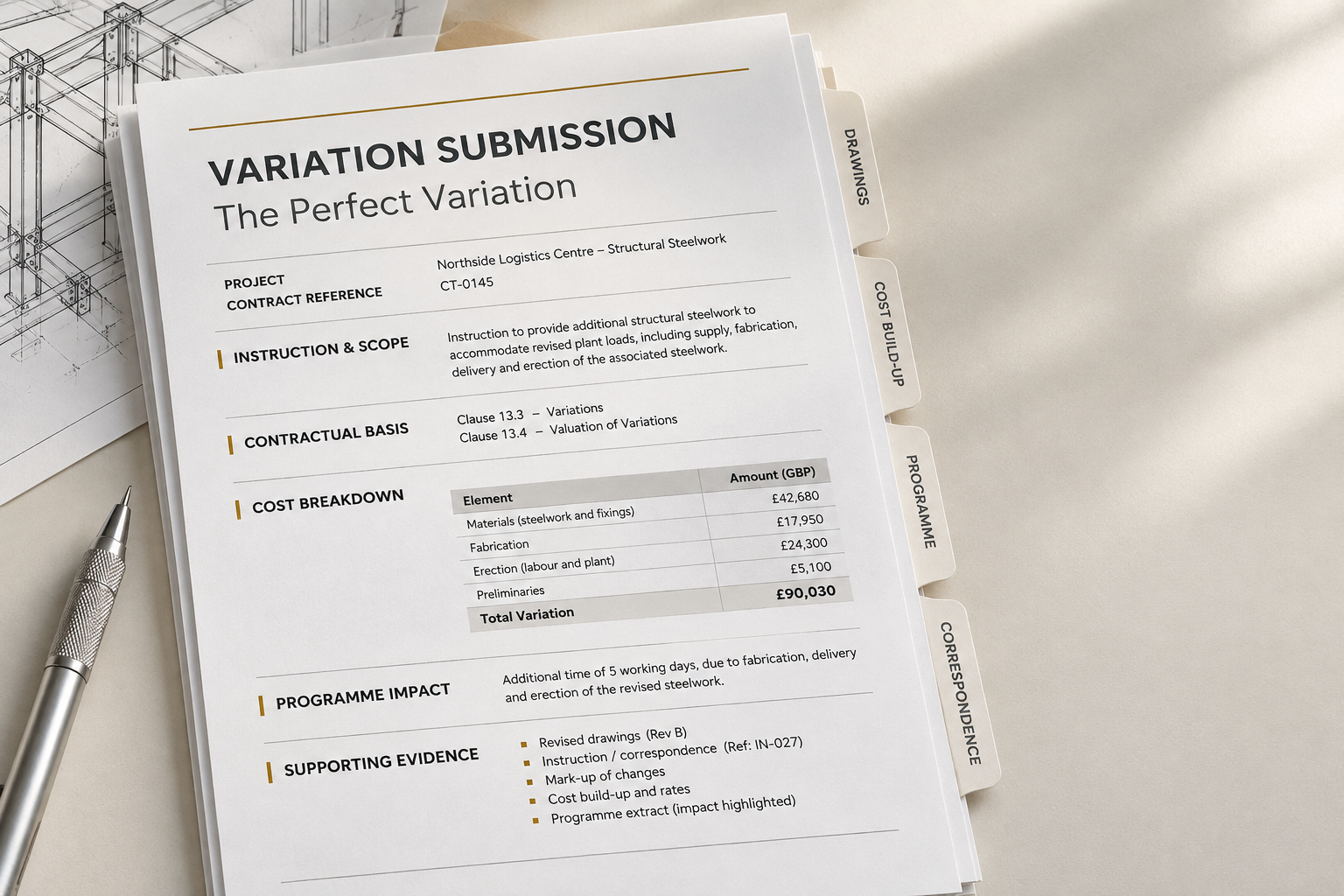
What this guide covers
How to Prepare a Construction Variation Submission
A good construction variation submission explains the original scope, the change, contractual entitlement and the valuation. This guide sets out how to build one.
Over the years, I've reviewed a considerable number of variations, ranging from relatively small changes to claims worth millions.
One thing that has always surprised me is how often contractors become so focused on the value of a variation that they forget to properly explain why they're entitled to the money in the first place.
You'll receive a submission explaining that additional steelwork was required, more labour was used or the construction sequence had to change. There will be spreadsheets, labour rates and a substantial figure at the bottom.
But quite often, the most important information is missing.
What were you originally contracted to do, what happened to change that, and why does that entitle you to additional payment?
It sounds simple, doesn't it?
Yet it's probably one of the most common problems I come across.
Start with the story, not the money
When I review a variation, the first thing I want to understand is what actually happened. Walk me through it.
We originally agreed to carry out the work in a particular way. This was included within our scope and price, as demonstrated by these drawings, specifications or contractual documents.
Then something happened.
Perhaps the client issued a revised drawing, changed a specification or instructed a different construction sequence. Whatever it was, identify it. Show me the instruction, correspondence, drawing revision or project record.
Then explain what happened as a consequence.
Did you need additional labour? More materials? Different equipment? Did you have to change how the work was being undertaken?
And, importantly, explain why that event creates an entitlement under the contract.
Once you've established those points, we can get into the valuation. Because without that foundation, we're just debating numbers without properly establishing what they're for.
Don't assume everyone will remember
One of the biggest mistakes contractors make is assuming that because everyone on the project knows a change has happened, there's no real need to document it properly.
Initially, that might not cause many problems.
The project team knows what happened. The contractor's QS and the client's QS have discussed it. Everyone generally accepts that some additional payment is due.
So the variation starts moving through the process.
But then things change. People leave the project. Management changes. Approval levels change. The client's commercial position might tighten, and suddenly the submission is being scrutinised by someone who wasn't involved in the original discussions.
Now they're asking questions.
Why did this happen? Who instructed it? Where is the evidence? How were these costs calculated? The contractor finds themselves trying to reconstruct events that happened six months earlier.
It's an unnecessary problem that could have been avoided by preparing the submission properly in the first place.
The contract exists for a reason
I was in a meeting recently where someone made a rather sarcastic comment about forgetting common sense and just following instructions.
I understood the frustration behind it, but there's an important point here.
A contract is an agreement between two parties about how they're going to work together. It establishes the obligations, procedures and parameters within which the project is supposed to operate.
And on major projects, the people making commercial decisions aren't necessarily sitting in the site meetings. There can be multiple layers of management, commercial governance and financial approval between the people carrying out the work and those ultimately authorising payment.
That's why notices, instructions and records matter. They're not simply administrative exercises designed to make everyone's life difficult, but part of the mechanism that allows decisions to be reviewed, justified and approved.
Of course, you still need to apply common sense. But everyone knowing something happened isn't necessarily the same as establishing contractual entitlement.
Don't throw everything at the valuation
Another mistake I see is contractors approaching every variation as an opportunity to claim the largest possible amount.
Let's say a variation is realistically worth £100,000.
Instead of carefully assessing the additional work and preparing a substantiated valuation, the contractor throws everything they can think of into the submission and puts forward £400,000.
After months of negotiations, it eventually gets agreed at £100,000.
Now, what have they achieved?
They've probably damaged their credibility. Because the next time they submit a variation, the client remembers what happened previously.
They start assuming the numbers are inflated before they've even reviewed the submission.
And that can affect every variation that follows.
Consider the position you've put the client's QS in. If they recommend a £400,000 variation for approval and it subsequently gets settled for £100,000, they're likely to face some difficult questions from their management.
Why did you put that figure forward? What checks did you carry out? How reliable are the contractor's submissions?
That's not a situation you want to create for somebody you're relying on to help get your variations approved. Your reputation for accurate valuations has a commercial value of its own.
You don't have to know everything
Now, that doesn't mean you should only submit a variation when every cost is known. On construction projects, that often isn't practical. Sometimes you're pricing work that hasn't started. Sometimes you've completed part of it and need to forecast the balance.
There may be genuine uncertainty around productivity, quantities, access or the resources required. That's fine.
The important thing is to be transparent.
Explain what you know, what you've allowed for and where the uncertainties are. Perhaps you've completed 20% of the work and have reliable records showing how much that has cost. Use those records to forecast the remaining 80%, making reasonable adjustments for any known differences.
If there are areas where the final cost could fluctuate, identify them and explain the assumptions behind your forecast. You can provide a realistic range or an estimate with clearly identified qualifications, where the contract permits that approach.
That's much more useful than presenting a heavily inflated figure and expecting everybody to negotiate it down.
You're giving the other party something they can actually assess.
I've seen the consequences firsthand.
I once took over a project from a previous QS and inherited a situation where the client's confidence in our variation pricing wasn't particularly good. We had a substantial variation involving modifications to hundreds of square metres of completed work.
We'd already undertaken approximately 20% of the work, so we had some reliable information to work from. We had timesheets, daily reports, photographs showing the work before and after, and benchmarked rates.
We used the work already completed to forecast the balance, allowing for the additional changes and uncertainties we could reasonably anticipate.
But when we presented the variation, the client's response was that our company always submitted inflated prices and that the final figure would be considerably lower.
I explained how we'd arrived at the forecast and walked them through the supporting information. They remained sceptical.
But eventually, the variation came out at approximately £350,000–£370,000, broadly supporting the scale of the original forecast.
The problem was that the client's QS had only allowed around £100,000–£150,000 in the figure he'd passed to his own client. That left him in a difficult position.
We ultimately got paid, because we had the supporting records to demonstrate the costs. But it was an uncomfortable situation that didn't need to happen.
The interesting thing was that it wasn't really caused by this particular variation. It was the consequence of the reputation established by previous submissions.
That experience reinforced something I've always considered important: Every variation you submit influences how the next one will be received.
Get the first few variations right
When you're starting a project, I think there's enormous value in putting particular effort into your first few variation submissions.
Make them tight. Make sure the contractual basis is clear, the records are complete and the valuation is properly substantiated.
Check everything before it goes in. Because those early submissions establish a precedent for how your commercial team operates.
If the client's QS repeatedly receives variations that are accurate, well evidenced and straightforward to assess, they'll begin to have confidence in the quality of your submissions.
Think about that from their perspective.
They might be managing ten or fifteen different subcontract packages, each producing variations requiring review, negotiation and approval. Some contractors consistently send poorly prepared submissions that need hours of investigation.
Others provide clear explanations, relevant records and calculations that can be independently checked.
Which contractor's submissions are going to be easier to process?
Naturally, every variation still needs to be reviewed on its merits. But a reliable track record reduces the need to repeatedly reconstruct the contractor's case.
It makes everyone's life easier.
Remember who you're actually trying to convince
Here's something I think contractors sometimes overlook.
The client's QS is generally reviewing your submission to establish whether it's properly supported and payable under the contract. They might have some delegated authority, but they're often not the final person authorising the expenditure.
They have their own management structure, approval procedures and responsibilities.
You should be thinking about that when preparing a variation. Your objective should be to make the client's QS's job easier, not harder.
You don't want your opposite number going into a commercial review meeting and being challenged because the variations they're recommending for approval are poorly substantiated.
Instead, give them something they can confidently take through their internal approval process.
Make the history clear. Demonstrate the contractual entitlement. Provide the relevant evidence. Show how you've calculated the value. Give them what they need to justify their recommendation.
There's nothing wrong with robust commercial discussions or disagreements about valuation. But you should never make it unnecessarily difficult for someone to agree with you.
The simplest test of a good variation
If I were giving a contractor one piece of advice before submitting a variation, it would be this:
Give it to someone who knows absolutely nothing about the project.
Someone who hasn't attended the meetings, hasn't seen the drawings and doesn't know the people involved.
Ask them to read it.
Can they understand what was originally agreed?
Can they identify the event that caused the change?
Can they follow the consequences, understand the contractual basis for entitlement and verify how the value has been calculated?
And, most importantly, could they explain to somebody else why the variation should be approved? If they can't, there's probably more work to do.
Because ultimately, a good variation isn't about producing the biggest submission or the most impressive spreadsheet.
It's about presenting a clear, properly evidenced commercial case that can stand up to scrutiny, even when the people originally involved are no longer around.
Get that right from the beginning of a project, and you're not just improving individual variations. You're establishing the credibility that makes every subsequent commercial discussion easier.
The perfect variation is one that makes it as easy as reasonably possible for the other party to say, "Yes, I can see why we should pay that."
Construction variation submission checklist
Before sending your submission, check that someone unfamiliar with the project can follow these six points. Apply the procedures and requirements of your own contract.
- Original scopeIdentify the work included in your agreed scope and price, with references to the relevant drawings, specifications and contract documents.
- Instruction or changeExplain what changed, when it happened and who instructed it. Reference the instruction, revised drawing, correspondence or project record.
- Contractual basisExplain why the change creates an entitlement under the contract. Identify the relevant clauses and check notice, submission and approval requirements, including applicable deadlines.
- Supporting evidenceInclude relevant records, such as timesheets, delivery records, photographs and daily reports, and connect each record to the work or cost it supports.
- ValuationShow how the additional amount has been calculated using quantities, rates and cost records. Distinguish actual costs from forecasts and state any assumptions or qualifications.
- Time impactState whether the change affects the programme or construction sequence. Where relevant, explain the impact with supporting records and follow any separate contractual notice or time-claim procedure.
Need support with a steelwork variation?
Discuss your variation submission, supporting records or outstanding commercial position with John Paul Oliver.